Showing posts with label miscellaneous rant. Show all posts

Thursday, February 05, 2026

"They may think it's a movement"

The first MTI cap fresh off the needles

Like so many of us, I have been watching - bearing witness - to ordinary citizens being subjected to brutality by their own government. Unlike so many times in history, this isn't happening in some far away country while we sit on our sofas in front our our televisions wallowing in smug satisfaction over our democracy. No. This is our crisis. This is our country falling into ruin before our eyes. 

I live in a "blue" state - I put that in quotes because I think that classification of blue vs red states is a false dichotomy. Yes, our nation is fractured, but it's not so easy to delineate where those fault lines are. And it's certainly not purely geography. 

And while there have been incidents of ICE disappearing people here in Massachusetts, we have not seen  the militarization of our state by swarms of masked armed and booted thugs like Minnesota and Illinois and Oregon and Washington, DC and so many more have. 

I feel powerless against this. What can one person do against an impending avalanche except stand there and wait to be swept away? 

So, I write letters and leave messages for my elected officials. I donate to mutual aid, activist, and charitable organizations in places that need it most. I have invested my time, energy, and money into my small community because the old hippie saying "think globally, act locally" is still true. Still critically important. 

It doesn't feel like enough. 

I'm a 62 year old woman recovering from major surgery. I can't put my body on the line in a protest - at least for now. There are stand outs in many of the little communities near me that I have participated in and will go again. Being around even a small group of people who believe as I do that no one is illegal and constitutional rights are granted to all is energizing. These small gathering aren't going to make ICE leave Minneapolis, but they add to the chorus of voices all over the US saying this isn't right. And that's important.

This week, protest has looked like a lot of red yarn on knitting needles and crochet hooks. I attend a weekly knitting group made up of mostly other post-menopausal ladies with white hair. We are just ordinary women. Making items for our loved ones and ourselves. We bring in our works in progress to ooh and ahh over. I am working on mastering cables. Another woman, toe up socks knitted two at a time, Still another, stranded colorwork. 

We are setting aside those projects and making the "Melt the Ice" red protest hat. 

Does it matter? 

I think it does. I think seeing a handful of woman walking around town wearing tasseled peaked red hats is a symbol. And when each of those women make several more hats (I'm on number 3) and more and more people walk around wearing them? Well, in the immortal words of Arlo Guthrie from 'Alice's Restaurant' well, "they may think it's a movement." 

I understand why there are some criticizing this as merely performative. But for one thing, the pattern has been purchased by thousands and thousands of yarn artists with all the proceeds going to support immigrants in Minnesota. (You can buy the pattern here.)  That's not nothing. Several hundred thousand dollars and going strong. But mostly, here's what I think: We need to show who we are and what we believe. Staying silent in the face of evil is evil. And if one person stops me and asks, "hey, what's with all the red hats," maybe that's a chance to divert the avalanche. 


Subscribe to BlueMusings and receive my short story collection, STRANGER WORLDS THAN THESE, as my gift.


Blue Musings is a low volume e-newsletter containing notifications about book releases, sales, recommendations, and free original short fiction in multiple drm-free formats. Your privacy will always be respected.

Sunday, January 25, 2026

Radical Empathy; Fierce Kindness


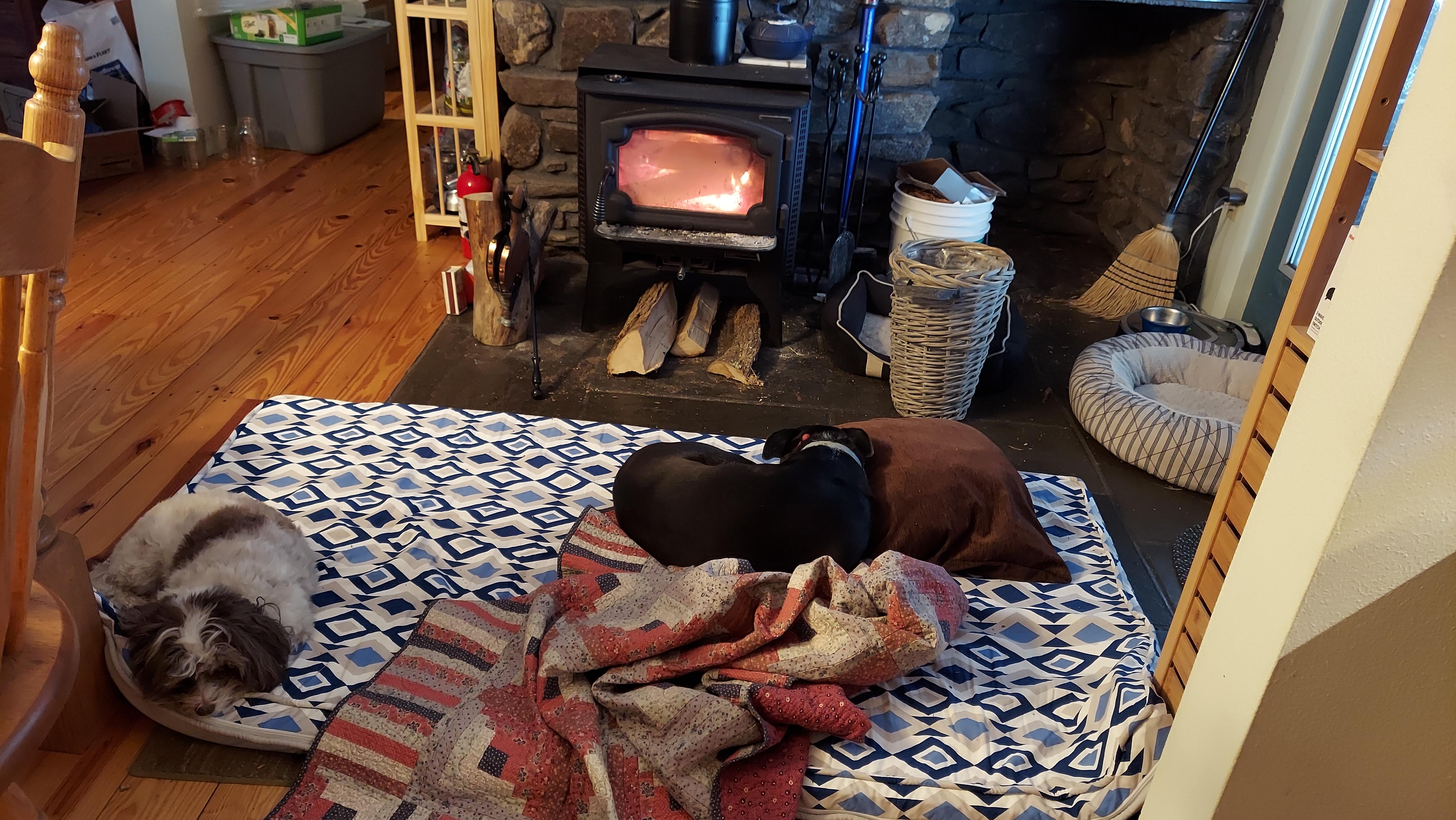
Dog, curled up on a sofa and blankets
Gigi - our dog who, like Aloka, brings peace to our hearts


The contrast between my internal life and the external world is stark. Painful. It's not as if I don't know what's happening in places like Minneapolis and all the other cities where innocent people are being terrorized by uniformed thugs. It's not as if I don't write my elected officials, make calls, go to local rallies, provide money to mutual aide. It's not as if I don't witness, horrified, as executions are taking place on our streets and we are being lied to at a scale that feels apocalyptic. 

I live in a tiny, rural town on 50+ acres of woodlands. It is a place of profound quiet. The chatter of birdsong and rushing water. The wind through trees. The call of coyotes. On clear nights, the stars are intensely bright. 

It's hard to reconcile that peace with the horror. How can both of those things exist at the same time in the same world? And yet, it has always been so. That is the terrible irony of being human - that we are capable of such beauty and such cruelty. 

During the same weeks as Renee Good and Alex Pretti were murdered, I have been following the journey of a group of Buddhist monks  as they walk from Texas to Washington DC spreading a message of peace. One of the aspects of their walk that has captured my heart is the story of Aloka, the Peace Dog. Aloka was a stray dog in India that began to travel with the monks, adopting them as his charge. The photos of him and the Monks caring for him illustrates some of the best of humanity. There is power in the simplicity of caring. 

I weep for Renee and Alex. For their loved ones. Their friends. The lives they touched. She was a poet. He was an ICU nurse. Decent people trying to make the world around them a better place. Their passion and caring didn't protect them. It makes me want to rage in fury at the unfairness of it all. It makes me afraid. 

I have two sons who are kind and lovely people. The type of people like Renee and Alex. They, too, have spoken out against fascism. They, too, have been to protests. I could see either of them doing what Renee or Alex had done - witnessing and protecting because it is the right thing to do.

Doing the right thing will not save us. 

Empathy and kindness are not shields against bullets.  

And yet.

And yet. 

Without radical empathy, without fierce kindness, we have no humanity. 

I don't want anyone's child or partner or parent or friend in harm's way.  

Doing the right thing will not save us. 

And yet.

And yet.  


Subscribe to BlueMusings and receive my short story collection, STRANGER WORLDS THAN THESE, as my gift.
Blue Musings is a low volume e-newsletter containing notifications about book releases, sales, recommendations, and free original short fiction in multiple drm-free formats. Your privacy will always be respected.

Monday, November 28, 2022

The False Urgency of Commerce

I have deleted hundreds of emails and text messages in the past week exhorting me to Spend! Buy! Save! Donate! 

To be honest, I love shiny things as much as any crow, but I'm done with the false urgency of commerce.

These not-so-subtle messages embedded in all these communications is that w are not enough. That we need to fill our emptiness with stuff. That we are judged on our acquisitions. 

I guess our society has always had this lurking, but it feels like it's ramped up to eleven this year. 

Fuck that noise.

We are wonderful for who we are. (Thank you, Mr. Rogers).

So share your weird and wild selves. 

We are the gift.


Subscribe to BlueMusings and receive my short story collection, STRANGER WORLDS THAN THESE, as my gift.


Monday, October 17, 2022

Work doesn't love you back

 Is it any wonder the message at large is that young people are lazy and don't want to work?


I don't make any secret of my age - I turned 59 this year. What that means in the context of this post is I was raised and came of age during a time when the workplace was sold as a second family and loyalty to work was something expected, as an unwritten, uncompensated requirement of employment. 

Despite the erosion of worker protections (this was the era of the slow disappearance of pensions as a new benefit and the abrupt loss of pensions to already retired workers), the message was still couched in the language of mutual obligation. "Take care of the company and the company will take care of you."

Things were starting to change in small ways and in certain occupations by the time I was in my late 20s. I distinctly remember a conversation with my sister - 7 years my senior and working as an accountant in one of the big firms - where she was appalled that I would leave a job after a mere year or two. Her exact words: "no one is going to hire you with that resume."

Well, there were distinct differences in the world of health care and as a newly minted physical therapist in the late 1980, I was in high demand, practically at any hospital in the nation. Still, the notion of your colleagues as a second family was definitely encouraged and as a young single person, I did spend a lot of time after work socializing with my work mates. And many friendships were forged along the way. 

However, there is an insidious undertone to this work-as-family theme: it places management in a kind of loco parentis, or at least as the authority figure with all of the subtle and not so subtle power imbalances that exist in family constellations. 

In truth, management does not consider the worker (except in exceedingly rare cases) as family. The worker - and this can be at any level, in any profession (ask me how I know...) - is simply a number on a spreadsheet and is completely exchangeable and expendable. 

These are the lessons I have been slowly learning from my children's generation. They have a much more realistic view of work and its place in a life. They see through the con, which definitely doesn't serve management/ownership. Is it any wonder the message at large is that young people are lazy and don't want to work? My 20-something children work and work hard, as do their friends. They are just better equipped to understand that work is purely transactional: their labor in exchange for fair recompense. 

Theoretically, you could work as a highly technical and highly skilled professional for many decades at the same employer, have a national reputation in your field, be lauded by your colleagues and professional organizations, have commendations from your employer regarding your exemplary contributions to the institution and none of it matters when it becomes convenient or expedient for the employer to sever your employment. 

Work. Does. Not. Love. You. Back.


Subscribe to BlueMusings and receive my short story collection, STRANGER WORLDS THAN THESE, as my gift.


Monday, April 18, 2022

I am not lazy


Nope, the dogs aren't lazy either


Some learning comes late. 

Once upon a time, I was a bright, curious child with a brain that wasn't wired along the same neurotypical pathway as most of my age mates. (Though that piece of understanding didn't come until my late 30s) And I got a lot of feedback - some meant kindly, some not so much - that I was lazy. 

 "Needs to apply herself more" was a consistent refrain on my school report cards. 

Another common theme was that I didn't stick with things. My mother always said I was 'jack of all trades, master of none.' 

If you hear those messages repeated often enough, they become internalized. They get validated. And they change how you see yourself as well as your own choices. 

So I learned to view my eclectic interests with suspicion and tried to focus on what a not-lazy person was supposed to be like. (Though I'm still not sure what that really is.)

Never mind that I completed my graduate studies, became a physical therapist, and had a very successful near 25 year practice. 

Never mind that I have written poetry for my entire life, starting in elementary school. 

Never mind that I took up long form writing and have written a dozen novels since 2004. 

Never mind that I started taking pottery lessons 15 years ago and am now the glaze technician for a studio and have my work in a gallery. 

Simply because I have had a hopscotch-like path through various interests makes me somehow suspect. And because along the way, I let other interests go, I must be a quitter. 

My past is littered with exercise equipment that turned into dust-gatherers. With workout memberships unused. Despite the fact that I prescribed exercise programs for hundreds and hundreds of patients over the years, I am shit at following them for myself. Clearly, I must be lazy. 

I am finally ready to tell that internalized voice to shut the hell up.

I am now closer to 59 than 58. Aside from living through a pandemic, the past few years have been rough personally. Between the changes of menopause, a need to be on annual cancer surveillance because of a genetic mutation, a preventative abdominal surgery, a fractured/dislocated shoulder, and a ruptured spine disk, my body has been through a lot. My left arm (broken shoulder) and left leg (S1 radiculopathy) were noticeably weaker than my right and it was interfering in my day to day life. 

A month ago, I remembered that my health insurance partially subsidized zoom based yoga classes. So I actively suppressed the sarcastic mocking from my own brain (lazylazylazy) and signed up.

For the past month, I've made the commitment to classes - 3 a week. For now, I will continue with them. Perhaps at some time, I will do the classes less frequently. Maybe even stop altogether. And you know what? It won't be because I'm a quitter or because I'm lazy. 

Sometime, we need certain activities in our lives because they serve a purpose. And it's okay to let them go if they don't fit, or no longer serve, or you discover something else better. 

So this is my reminder - to myself and to anyone else who needs it: you are not the stories others made for you. And I am not lazy.


Subscribe to BlueMusings and receive my short story collection, STRANGER WORLDS THAN THESE, as my gift.


Monday, May 13, 2019

What's the appeal of so much pain?


There will not be any specific spoilers to Game of Thrones material here, though I will talk about the show in general ways.

I don't actively watch GoT. My husband follows the show, so I tend to hang out in the living room and either knit or work on my laptop during it. There is a lot to appreciate about the series, not the least of which is its production values. But I don't enjoy it.

There's a critical difference between stories that show characters battling darkness (internal or external) and finding their triumph versus stories that glorify pain.

I don't enjoy the latter. Not to read. Not to watch. Not to write.


When I was in my teens/20's, I read a lot of dark stuff and loved it. (The Chronicles of Thomas Covenant comes to mind.) Now, it just magnifies the dark I've experienced. Over the past several decades, I've lived through the slow decline of my mother's mind and her eventual death from complications of dementia. Helped my father through his end of life journey when 7 years of dialysis were too much for him to bear. Mourned so many loved ones. Escaped a burning house with my family and the clothes on our backs. Experienced great disappointments and great pain. Nearly lost a dear one to suicide.

The longer I've lived, the more pain I've experienced and witnessed in my life. And the less I want to find that kind of pain in what I read and watch for entertainment. 

It's why I can watch a zillion versions of Twelfth Night or Two Gentlemen of Verona, but I don't think I can ever sit through another King Lear.


I recently saw The Ferryman on Broadway with some friends. It was a masterful performance that left me reeling. It was like King Lear meets Ethan Fromme and as incredible as the play, the staging, the acting were, the ending was a gut punch. Not a sucker punch, thankfully, because the show laid enough foreshadowing that you knew it wasn't going to end well.

I don't think I would have chosen to go to this show on my own. It was recommended to me as a writer by a writer friend I trust. And yes, on a craft level, there was a lot to learn and absorb from The Ferryman.

While I don't regret seeing it, I don't need to ever see it again. And thank the gods of writing that there was humor and lightness in the play, because otherwise, it would have been unwatchable.


It's not that I want false cheer in my entertainment. I enjoy cotton candy or peeps now and again, but that does not a healthy diet make.

I don't understand the appeal of so much pain. It's why I never read past GRRM's first book in the Song of Ice and Fire series. Not because it was poorly written - it wasn't. I've often said you could run a masterclass on writing point of view using that first story.

It was because the pain depicted became (for me) the point of the story, rather than a part of the story.

I will never write that kind of unremitting darkness anymore. I have several trunked novels that will never see the light of day because they are full of pain for no other reason than I had internalized a lot of stuff from my early reading.

My stories have pain and sadness in them; that's part of life and I don't want to shy away from expressing a full range of human emotions in my work. But, even Pandora found hope after freeing all the misery and evil trapped in the box. 

If you enjoy SF&F stories with some hope and endings that leave the characters transformed, but not tortured, I have a bunch you might like. You can check them out on my website. 


Subscribe to BlueMusings and receive my short story collection, STRANGER WORLDS THAN THESE, as my gift.


Tuesday, April 23, 2019

No courage without vulnerability


I watched The Call to Courage (the Brene Brown Netflix special) last night and it hit me hard. Her overriding message: There is no courage without vulnerability. That failure is part of being brave. That we cannot be our full selves if we spend our energy staying armored against our fears.

I know that my best work and my best self emerges from allowing myself to be vulnerable. But it comes with so much fear tangled up with shame. It doesn't feel brave at all; it feels like I'm drowning in a whirlpool of muck.

And so I hold back. Struggling at the edge of a shit-vortex while assuring everyone around me that *everything's fine.*

And I have so many reasons why everything should be fine: Financial security. A loving and supportive marriage. A happy home. Puppies. A creative pursuit. A healthy relationship with my adult children. Good health. True friends.

So many things to be so incredibly grateful for.

And still.
And still.
And still.

I hold back.

I am afraid.

And when I try to talk about it, all I hear is myself being a whiny toddler. It's as if because I have so much support in my life, I have no right to struggle. I'm entitled, so I'm not entitled, if that makes any sense.

Maybe it's just the time of year. Anyone who's known me for long enough knows I go through a depressive spike in early spring. Why? Have no idea. It makes no sense. The light is back, the weather is warmer, the colors are returning. But every year in April and May, my anxiety ramps up.

In the past few years, it's been exacerbated by several difficult anniversaries. 6 years ago tomorrow, I nearly lost a loved one to depression and 4 years ago next month, is my father's yertzeit.

I share these things because it helps me to figure out my emotions when I write about them and because if I'm not honest about my struggles, I won't find my way through to courage.

Trust me, I'd rather hide behind my well-practiced surface persona then be vulnerable. But I'm also emotionally weary of beating myself up for not being that person.

I'm starting to understand the cost of being neuro-atypical in a world that isn't designed for me. Most of the time, I can manage all the spinning plates. I have systems in place to pay all the bills on time, make sure laundry gets done, feed the dogs, feed me and my spouse, set and follow writing deadlines, and more. But just because I can function, doesn't mean I'm not also prone to anxiety and depression, or don't get overwhelmed by sensory stimulation, or don't get panic attacks from the daily news, or am able to 'roll with it' when my routine is upended.

Most people would never see me as neuro-atypical, but the reality is I'm on the autism spectrum. And regardless of how well I can mask and function, the way my brain is made and how it works doesn't go away. I have to account for it every day. How many environments have I had to navigate today? Do I have the internal resources to make a phone call? Can I cope with a potential conflict? It's a calculus I do constantly.

Last Wednesday, I had to go to 3 unfamiliar grocery stores to buy food for Passover. It was exhausting. Not physically, precisely, but the sensory barrage and the anxiety of finding my way in a new physical space was utterly draining.

Sounds silly to be so flummoxed by grocery shopping. I've done so many difficult and challenging things in my life and done them well. Apparently, grocery shopping is not one of them.

But I did it because it needed to be done and I managed the emotional cost of it. Is that a kind of courage? Maybe. It feels more like stubbornness, but maybe that's what it has to be.

I am not looking for sympathy or answers. I'm not looking for anything from outside of myself. Maybe I just needed a place to be honest and vulnerable and even a little bit brave.


Subscribe to BlueMusings and receive my short story collection, STRANGER WORLDS THAN THESE, as my gift.


Tuesday, March 19, 2019

What makes a professional writer?


My personal bookshelf: 8 novels published in 6 years

This is one of my periodic musings/rants on the state of publishing. As ever, this is my opinion, based on my experience and YMMV.

Depending on your definition, I'm either a professional author or a hobbyist writer. Personally, I'm not sure it matters. And I'm okay with that.

I came to writing after spending almost 25 years as a physical therapist, working in a variety of settings from hospital-based inpatient care to an outpatient private practice. I earned a good living and spent significant time and money on professional development so I could stay current in my skills.

I had the opportunity to speak at professional conferences and contribute to the research literature as well as write chapters for text books.

There is no doubt that physical therapy was my profession.

During my latter years as a clinician, I started to focus on long form fiction - as a hobby. While I can't deny holding to the fantasy of having one of my manuscripts discovered and published to world-wide acclaim, I understood that this was fantasy. Being an author wasn't my job at that point.

However, I was also the parent of two children, and as their needs changed, I also shifted my working priorities to part time employment which allowed me greater flexibility to care for my sons.

Just because my earnings decreased as I limited my work hours didn't suddenly demote my work to hobby status in the eyes of the world.  Whether I worked 10, 20 or 40 hours a week as a PT, I was still a professional. And that designation remained whether I was the primary 'breadwinner' of my family or not.

Fast forward to 2012 when I published my first novel. By then, I had disbanded my physical therapy practice and was no longer working as a clinician. I remained a licensed professional, even as I didn't earn any income in that profession.

I may have earned $500 in 2012 from that first venture into publishing.

So where did I stand as a writer? Professional? Hobbyist?

Would it matter if I said I spent time and money on professional development? Wrote consistently? Sought feedback on my work? Learned about the changing landscape of publishing? Had an agent? Went on submission?

If your definition of professional is someone who earns a full living from their chosen work, then there were many, many years I wouldn't have been considered a professional physical therapist. Without my spouse's income, there were years I wouldn't have been able to pay the rent, childcare, and basic needs for my family.

Let's fast forward again, this time to 2019.

I have 8 novels in the marketplace.

My average annual income as a novelist is approximately $6,000 - $12,000 a year, depending on if I have a new release or not. That is not by any definition 'a living' - not when you have a family to support.

So, am I a professional author? A hobbyist?

Would it change your mind if you knew I was a full member of SFWA? An invited guest speaker at well regarded genre writing conventions?

If your definition of professional has an income requirement attached, then the percentage of writers who are professionals is vanishingly small.  Yes, there are writers earning good money. They are the outliers. Trust me. I know a LOT of writers. Most of them don't earn the equivalent of minimum wage from their creative work. And some make far, far more than that.

Still others sell a ton of books and plow nearly all their earnings into promotion and advertisement, writing fast and furious in search of audience share. That is a route I have seen lead to financial success, but it requires a kind of relentless focus on the numbers (both books written and sold) that doesn't work for me and would lead me smack into the brick wall of burnout.

And honestly? I don't see all that much of a difference between my traditionally published writer friends and those who go the indie route. Some writers will do extremely well. Some rare writers will be in the right place at the right time and grab that brass ring.

Yes, hard work and discipline is certainly a factor in artistic success - and it's the only part of the process the writer has any control over - but even the most successful writers will tell you how much luck and timing had to do with it.

It was far easier for me to make a living as a physical therapist then it is as a writer. I suspect most artists of any stripe will say their 'day jobs' make more financial sense than their art work.

And none of this means that artists cannot also be professionals even as they pursue their art as part of their life. As a hobby, if you will.

I think the biggest problem with the professional/hobbyist divide is that society has conflated pursuing a hobby with dabbling and all the negative connotations it carries.

I would love to reclaim and redefine the word hobby in a way that doesn't place it on the opposite side of some imaginary continuum where "professional" is the other end.

Perhaps we would all be better off with less of an artificial separation between vocation and avocation.

If you're looking for me, I'll be searching for that elusive balance.


#SFWApro


Subscribe to BlueMusings and receive my short story collection, STRANGER WORLDS THAN THESE, as my gift.


Tuesday, January 29, 2019

When social media doesn't work as planned


Mya is an expert at blanket fort. 


I'm an introvert.

While that may surprise some who know me from social events, the reality is while I can be quite gregarious in public, I pay a heavy price for my energy outlay. (Case in point: I am still recovering from the intense 'peopling' during Arisia.)

For folks like me who are introverts and also creatives, the internet was supposed to be the great equalizer.
Be social on your terms! Discover a tribe, a community, an audience while never leaving your safe and comfortable blanket fort! Be protected behind your screen persona! 
While to some extent, all those promises are part of the internet and social media, it's more of a "yes, and" proposition. The "and" part being that even asynchronous and curated interaction can be stressful. And that's when the interactions are relatively benign ones. For the time being, I'll put trolling and harassment to the side here, though those negative interactions seem to hit the introvert and/or socially stressed harder than the socially comfortable/confident.

And I certainly can't speak for all introverts on the internet. This is my experience. These are my musings. YMMV.

I tend to be an early adopter of all things techie and social media was no exception. I was part of the early AOL message board community and then jumped to blogging in 2004. RSS readers were my jam. They helped me keep up with folks all over the world using blogs to do short and longform essay writing, prose, poetry, and sharing images.

Then came the more overtly commercial platforms: facebook and twitter and pinterest and tumblr and google+, among others.

I made logins for all of them and for a time, tried to keep up with the communities of users in each one.

It was exhausting and instead of focusing on my blog and my own writing, I went from new posts here every 2-3 days to maybe writing something once a month. It was as if the entire landscape of social media morphed from a place to express myself to a place where I needed clicks to validate myself. It got to the point where I felt I was only interacting to get that little seratonin hit whenever someone would notice me.

And you know what? It was all draining. Being noticed is exhausting. Not being noticed is exhausting. Managing all those communities is exhausting.

I am not a small-talk kind of person. If I have a conversation, I want to dig deep and wrestle with the problems of the universe with you. In my offline life, I have a handful of intense friendships and even those folks understand that I may not see them or talk to them in weeks or months before picking up where we left off. I am the kind of person who will drop everything for a friend in need, but have a panic attack if I get too many social invitations in a month.

Computer based social media should have been the perfect place for me.

And I thought it was.

Until I realized how many hours I spent relentlessly refreshing notifications.

Part of this understanding has come by way of the loss of Google+. I spent a lot of time and energy cultivating relationships on G+. I found an amazing contingent of fellow creatives and just fascinating people talking about really interesting things. We shared long conversations, friendly arguments, and terrible puns. I invested a lot of myself there. And Google basically sabotaged the place - both actively and through neglect - until they announced its shuttering.

By then, I had dropped my investment in the other platforms to maintenance mode. Which is primarily where I am now: make minimal comments on posts that amuse me, try to post witty things that will garner notice. It feels narcissistic and shallow, but I can't seem to help it. The thought of putting any more work into a siloed network where users create the content and the value, but are only an afterthought to the commercial interests behind them makes me want to scream.

We've been sold the belief that social media is there for creative people to reach their audience. But I no longer think that's true. WE are the audience. And what social media is selling is our own attention back to us, but fragmented in an endless, recursive loop.

I am trying to find my way back to using the internet in a way that sustains me, rather than drains me. But I'm not sure what that looks like, to be honest.


Subscribe to BlueMusings and receive my short story collection, STRANGER WORLDS THAN THESE, as my gift.


Tuesday, December 18, 2018

The 10 Commandments of Elie Wiesel

This afternoon, I was listening to WBUR as I was prepping dinner, and heard a moving story about Elie Wiesel's life and legacy as told by Rabbi Ariel Burger, a former student who became a colleague and then a friend.

Rabbi Burger had put together this from his time in Wiesel's classroom and so much of it spoke to me.

Ten Commandments of Elie Wiesel
By Ariel Burger
  1. Listen to a witness to become a witness.
  2. Don't kill the dead again by forgetting them.
  3. Enter madness if necessary to awaken sleeping communities.
  4. Don't let the enemy define you.
  5. Any one life is worth more than all that's been written about life.
  6. True prophets don't comfort; they disturb.
  7. Remember to laugh in spite of all the darkness.
  8. There is always something you can contribute – even if it's just your protest.
  9. Worship God by arguing with God.
  10. Sometimes there is no meaning. But then we must make meaning.
Of all of these, I am most struck by the last one.

Sometimes there is no meaning. But then we must make meaning.

That speaks to me as a poet and a writer. In a world that seems dark and ominous and where I feel so very vulnerable, writing is an act of valor, of defiance, and of creation. 

I have a friend who is struggling to make sense of her past and to find a path for her future. I have urged her to start journaling, not as a means to make a living with words, but to bring clarity and self-compassion to her life. 

Until I have written down the words, I often don't truly know how I feel. Finding the way to describe an experience is akin to sorting through a pile of stones for a handful of the right size, color, and heft. I often consider each word - alone and then next to its fellows. Does it fit? Does this phrase carry the meaning I need? Do the lines resonate with one another? And above all, will the language I craft organize the tangle of emotion into something I can understand and view from outside of myself?

Then I find peace and acceptance. Patience and compassion. 

Words are my tools to make meaning from the chaos of existence. This is more than capturing the accuracy of a memory. Our minds are not video recorders. Our memories are always in flux. Our interpretations of those memories change, depending on current life events, emotions, and our interactions with others. In effect, our lives are in a constant state of creation and recreation. 

Without the transformational power of art, I would argue that we cannot make meaning. Events would crash over us like the relentless tide on a rocky beach. Without transformation, we react,  lacking the space for reflection. Without reflection, there is no understanding, no wisdom. 

That final commandment is an obligation. We must make meaning, especially when there seems to be none. And yet, there is a danger in this, too. Especially if the meaning we make is one that distorts rather than illuminates. 

As I have lived through the political upheaval in my country these past several years, it occurs to me that we have become vulnerable to letting meaning come from without rather than from within.  We practice less introspection and reflection and instead abdicate our responsibility to self by accepting prefabricated and neatly packaged versions of our experiences. Is it any wonder that so many of us feel fragmented? Strangers to our selves?

It's been far too long since I've kept a journal consistently. Perhaps it's time to return to my old practice and use it as a way to interrogate my emotions and beliefs. Maybe the meaning I seek is waiting for me there.    


Subscribe to BlueMusings and receive my short story collection, STRANGER WORLDS THAN THESE, as my gift.


Tuesday, October 30, 2018

The Importance of Small Joys


This was the start of a thread I posted on Twitter this morning. I wanted to keep it all in one place, so I am sharing it here as well.

In every quiet moment, I try to focus on hope. And I repeat this over and over:

May all beings be held in lovingkindness.
May all beings be at peace.
May all beings be free from suffering.


I struggle on social media about boosting all of the terrible acts of evil around us.

Am I adding to the despair?

Or helping to warn people of good conscience?

If I let the evil pass without comment, am I complicit?

If I celebrate small joys, am I minimizing the pain & suffering around me?

If I deny those small joys, am I allowing evil to win?

A dear friend posted this to my FB wall. Because I love word-based puns, & I'm a potter.


I had two loved ones send me silly things today that made me laugh.

I am grateful for the momentary respite. It feels right and good to find something positive to cling to.

Right now, it's a blue VW Bug with the license "Alonzz" my son sent me.

My son took this when he was stuck in traffic this morning. Any day that starts with a Doctor Who reference is a good day.


Maybe that small joy is what allows someone a burst of hope & energy to keep fighting.

So I will keep sharing silly dog pictures & groan-worthy word play.  And I hope you will keep sharing those with me, too.

As we fight. As we keep fighting.


Subscribe to BlueMusings and receive my short story collection, STRANGER WORLDS THAN THESE, as my gift.


Wednesday, August 08, 2018

Playing the Long Game

I'm taking a brief break from the long and twisting tale of my adoption search story to return to some hard numbers about my publishing journey. I do this periodically, mainly because I believe in transparency and it helps me maintain perspective.

First caveat: I am almost entirely self-published.
Second caveat: I do very little promotion or paid advertising. I have a small mailing list of under 1000 subscribers. I could probably earn more/sell more if I focused on this side of the business.
Third caveat: I walked away from amazon page reads to keep my books widely available. This resulted in a definite drop in income that I'm starting to recover from. It was a long term choice to eschew the immediate money for long term sustainability.
Fourth Caveat: I have learned I can write/publish a book a year and no more than that.
Fifth caveat: YMMV


This is an overview of my earnings from January of 2012 through yesterday, August 7, 2018.

I've marked when each of my 8 novels were published. They are color coded for the series they belong to.

A few things to notice:

2014 was an anomaly year. In June of 2014, I published DERELICT, the first novel in my space opera series, Halcyone Space. I did little that I hadn't done for my prior books, but this one (forgive the terrible pun) took off like a rocket.

There were fewer books being published in 2014 and Amazon's algorithms (impenetrable to mere mortals, then and now) somehow picked up on a week or so of modest sales and decided to promote the book in its genre newsletters.

Unfortunately, I had no way of capitalizing on this good fortune directly, as Amazon doesn't share its sales intel. While I had my social media links in the book and a link to my newsletter, I had no way to directly promote to all those readers.

One year later, when ITHAKA RISING was published, (book 2 of the series) I had no way to let all the readers of book 1 know it was out. And Amazon didn't magically do it for me. You can clearly see the tiny bump in income for that release. However, sales of all books over the following months were slightly higher than in the prior year.

In 2016, I had greater traction with the release of DREADNOUGHT AND SHUTTLE, again mainly due to the power of Amazon: At that point, I had taken the newer books exclusive to Amazon in their Kindle Unlimited program and a big chunk of my income that year was through page reads.

Book 5 (PARALLAX) debuted in 2017, when I had pulled out from KU to have all the books available wide. My income between mid 2017 to mid 2018 was given a lovely boost by a .99 Bookbub feature on DERELICT.


This second graph is a yearly comparison of earnings between January of 2012, when I published my first novel, through yesterday, August 7, 2018.

With 8 novels in the marketplace, and a completed series, and greater traction on non-Amazon marketplaces (especially Kobo), I'm on track to exceed my KU exclusive/boosted-by-page-reads 2016 income.

If you omit the outlier of 2014, and factor in the switch from Amazon exclusive to wide, the trend is towards higher earnings year on year with more books available in the marketplace. (Note: the 2018 bar is only 7 months of the year and doesn't include the earnings from my latest bookbundle participation.)

Take Home Messages

  • Publishing is a long game
  • More of your books in the marketplace translates to more potential points of contact and sales
  • Amazon is still the biggest player in the market. Some writers choose to stay exclusive with them and can do extremely well on page reads and the specific promotional tools that gives them. 
  • Going wide entails risk and it can take a long time to gain audience share outside of Amazon
  • Of my 8 novels to date, 4 have earned back their production expenses, the 5th is on track to do so. 3 have not and probably will not. This is the case even in traditional publishing: good sellers bankroll poorer sellers.
  • This is not the business to be in if you need a steady income. AKA keep your day job or have a partner with one. 
  • Luck and timing play a larger role in financial success in publishing that any of us want to admit. 
  • You have no direct control over luck or timing. 
  • Hard work is necessary, but it's not enough.
  • If you, like me, find creating as necessary as breathing, there is no hope but to keep working. 


Subscribe to BlueMusings and receive my short story collection, STRANGER WORLDS THAN THESE, as my gift.


Wednesday, June 20, 2018

What are we afraid of?

I went to morning services at my temple this morning. I went because someone in the community had a yartzeit - the anniversary of a death of a loved one - and the laws of Judaism require a minyon, a quorum of 10 participants in order to recite the memorial prayer.

So I went, more in service to the community than for my own beliefs, which are conflicted and complicated.

But that's not why I'm writing today.

I'm writing to sort though my emotions and thoughts about the conversation the group had after the service, over coffee. We were talking about the incarcerated children, about immigration, and I was disappointed and upset by the opinions of my fellow congregants. And this is a community that prides itself on its commitment to social justice and social action.

Ultimately, the consensus was, sure, babies and children in detention centers is sad, but what else are we going to do? Several times, my view was challenged with this question: So would you rather have open borders?

Behind that question (and I'm sure the querant looked at it as a rhetorical one), I see fear. Fear of the other. Fear of change. Fear of loss. Fear, couched in the language of law and order and reason and fairness. And hours after the conversation, I sit here wondering what would happen if we stopped trying to logically justify our emotions and were truly honest about what we felt.

Instead of calling humans illegal, would would it be like if we could admit:

  • I'm afraid of people who don't look like me
  • I'm afraid of people who don't act like me
  • I'm afraid of people who don't worship like me
Sitting in a room with a handful of people, most of whom were working hard to make me wrong and them right, many who were clearly ready to dismiss my passion as naivety, it was hard to muster any kind of answer that they could hear.

When I got home, I started to understand that using logic and reason only made it easier for them to hold to their arguments. That for every fact I checked, they would throw two more for me to counter - a hydra of data. It was a powerful defense mechanism, a way to wall away uncomfortable emotion.

As a woman, I'm far too familiar with being told not to be emotional. To being called hysterical. To being dismissed for leaning on my feelings. But to be human is to be a bundle of emotional reactions. We feel first; rationalize after. We know this. It is neuroscience, not opinion. 

I know now how I will respond to the kinds of questions posed to me today after services. I don't know what kind of answers I will receive, nor if it will change the conversation, but I will ask it anyway. And keep asking.

What are you afraid of?


email:

  • Free eBook
  • Free/DRM-free short fiction
  • publication news

Tuesday, February 20, 2018

So you want to be an ally


This post emerged from my observations and experiences, especially over the past year and in response to the #BlackLivesMatter and #MeToo movements. This is by no means an authoritative or complete guide to allyship - that would be a pretty large ego-driven statement - but it is something that's been bouncing around my head and I thought I would start to lay it down in words.

I welcome comments and suggestions.


1. Examine and understand your motivations


You don't get cookies or gold stars or a cool t-shirt for performing the role of ally. It's not something you can cross off your bucket list, like "Visit Iceland" or "Climb Mt. Everest."

Being an ally is a position or identity you stake out in your life. An avocation, if you will. More like being an amateur painter or musician. And as such, it means committing to a lifetime of practice and learning.

And if your motivation for being an ally is "so people think I'm a good person", stop. Just stop. You are making this all about you and your ego.


2. You must be willing to risk your position


Congratulations - you have come to a point that many do not: you recognize that you have benefited from society's inherent biases. That while you may have worked hard for what you have, you started out at a more privileged position or easier difficulty level. And you want to do something about it. That's great. A level playing field seems like the right thing to fight for.

There is no fight without risk.
There is no change without loss.

You may lose your standing in your family, your place of worship, your profession, your neighborhood.

If you do your work well, you may see yourself be passed over for promotion or opportunity in favor of someone in a less privileged position. And that may hurt, because deep down, whatever our politics or outward actions, we believe we earn what we have achieved.

Understand that in a more equitable world, you may not always get the winning lottery ticket. If you've always gotten them in the past, that will feel like a loss, instead of a correction to a rigged game.

3. Amplify, don't shout over


The main jobs of an ally are to listen, educate, and amplify.

Listen: make sure you really understand what the people you wish to ally with want. And this may be more difficult than you think. There is rarely complete consensus in any group and just as you cannot speak for all white people, you cannot think that anyone speaks for all people of color, or all women, or all people in the LGBTQ communities, or all Muslims, or, or, or. And that's not even acknowledging that individuals can and do belong to more than one marginalized group.

Educate: Educate yourself and your fellow folks in privileged positions. Read foundational source texts from folks in marginalized groups. For all that is good and pure in the world, DO NOT MAKE THOSE YOU WISH TO ALLY WITH do the emotional labor of educating you.

Amplify: Here's an example: Imagine you are an actor. Spend time actively promoting movies with actors from marginalized groups. Talk them up on social media. When someone praises your role in a specific show, thank them and recommend something from a group you wish to be an ally with. Same for artists, musicians, writers, etc. Use your platform to boost voices that wouldn't otherwise be heard.

Frequent shops owned by people from marginalized groups. Use the power of your economic privilege to support them.

Signal boost; don't obliterate with your voice. That's a callback to point #1: If you are talking OVER marginalized voices in your effort to be an ally, you aren't. That's ego. Examine your motivations.

_________

I wrote this post as much as a reminder for myself as well as for my fellow white folks, both allies and potential allies. I know this is not a complete list and if I have make any errors or omissions, I apologize and will edit as needed. 

Know that this is hard work.
Know that you will make mistakes.
This is okay; learn from your mistakes.
No change happens easily.
Change can happen.
It must.


email:

  • Free eBook
  • Free/DRM-free short fiction
  • publication news

Thursday, January 18, 2018

A lifetime of learning

Fred Rogers, image in the public domain

From the outside, I pretty much look like a competent grown-up. Someone who has it all together. Well, I have been circling around the sun on this blue planet for over 5 decades, so I've had a long time to learn some stuff. But the reality is, I'm still learning and I'm still changing. And, no, I don't have all the answers.

I have learned to think deeply about all sorts of things and especially to interrogate my own most closely held beliefs. Honestly? That's my definition of adulthood - being willing to examine your biases and change them. It's toddlers who hold to irrational beliefs and throw tantrums when they are challenged. Grown ups shouldn't do that.

All too often they/we do.

These are some of the things I've been thinking about/lessons I'm working to learn:


1. Not everything is about me. Not everything is for me. Every space doesn't need to cater to me. Shutting up & listening without needing to offer my opinion is a useful skill.

I'm a white, cis, het woman in her middle age. I have A perspective, but not THE perspective. And to be honest, my perspective is more widely understood and accepted than those of someone more marginalized than me. While in some contexts, I may be the marginalized voice, in so many more, I am privileged. My job, when I am privileged, is to clear the way for other perspectives. And not expect a cookie or a pat on the head for it.


2. I have the responsibility to ask for what I want, not the guarantee that I will get it. 

I spent far too much time worrying about pleasing (or simply appeasing) people around me. Somehow, I was convinced that I was only likable if I catered to what everyone around me wanted and needed. This does a number of very unhealthy things: It made me believe that what I wanted was not important. It made me believe that I had to manage other people's emotions at the expense of my own. It made me believe that others - if they truly cared about me - would know what I wanted or needed. In short, it encouraged me to act in a passive aggressive way and to deny my own agency and personhood. 

3. I have learned that empathy is not the same as subsuming my needs for someone else's. 

This is closely linked to the point above. I had to learn that I had the right to have preferences that differed from those of the people around me. This reverberates in small matters and large: the movie you want to watch, the way in which you and a partner express sexuality. 

4. Disagreeing doesn't mean the end of a relationship. . . 

I used to believe I had to agree with/enjoy everything my friends did, or I was being troublesome or rude or disruptive. Somehow I was convinced that by saying "No, I don't want" or "I don't like" would end the friendship. It was *my* job to bend to the needs of those around me. What I've learned is that clearly having an opinion doesn't negate the opinions of others. We can like different things and still be friends. I know! Radical! 

5. Except sometimes it does. 

Opinions about favorite Doctors (Doctor Who), or Star Trek franchises, or pie varieties are not fatal differences. (Though I will fight with all my strength if you tell me that canned pumpkin makes as good a pie as fresh.)
I have given myself permission this year to distance myself from individuals in my life who hold political beliefs I feel are incompatible with empathy and democracy. If you make a joke in which you 'punch down' and when I try to talk to you about it, you tell me I have no sense of humor, I will walk away. If your facebook feed is full of memes that are actively hurtful to people in my life, I will walk away. If you continually act to bait me or my friends in arguments manufactured to make us justify our existence, I will walk away.  


6. WWMRD

Finally, I may indeed judge myself and others by Mr. Rogers's standards of decency. If he would have been disappointed, perhaps we need to rethink our actions. 

If you have lessons you'd like to share, please add them in comments. This list is certainly not exhaustive and I'm still learning every day. Just don't challenge me about the pumpkin pie. ;) 


email:

  • Free eBook
  • Free/DRM-free short fiction
  • publication news

Monday, October 16, 2017

Reclaiming ourselves

A moment of peace, for everyone who shared their #MeToo moments


Watching the flood of posts on social media yesterday with the tag #MeToo was painful and eye-opening. I have a lot of folks friended on Facebook and nearly all the women and some of the men openly proclaimed that they, too, were victims of sexual assault or harassment. 

Some people talked about the need to be outspoken in order to show the scope of the problem to so many men who disbelieve women, or worse, mock them. For me, it served a different purpose. It showed me how many strong, incredible people have also been sexually victimized. It showed me that I could examine my own experiences in a very different context. It showed me I wasn't alone or weak or to blame.

Not if so many amazing women (and some men) on my timeline had their own #MeToo stories. 

I have no need or desire to recount the details of my assault. It doesn't matter how old I was or the circumstances. I don't need to parade my history for it to be important, relevant, formative. But I will tell you this: I was a child and my abusers were teenage boys from my neighborhood. And the questions we need to be asking as a society are why did they think they had any right to my body or my ensuing silence?

*

I was a child of the 60s and 70s. The cultural zeitgeist was the sexual revolution and perhaps it was a seismic change in how we viewed sexuality, but looking back from our current moment, it seems like it lacked a basic and vital component: We had no language for or concept of bodily autonomy.

I was raised to 'be a good girl', to comply. The accepting and giving of hugs and kisses to relatives and family friends was compulsory. I remember being tickled to the point of nearly throwing up on many occasions. If I complained, I had no sense of humor. 

Does the fact that I see forced tickling as a violation of my bodily autonomy seem minor and petty to you? 

If it does, then I would ask you to examine why. Why should my personal experience and preferences mean less than your right to use my body how you want to? And if it sounds like I'm equating tickling with assault, I am, because it's a similar control issue. They are not the same, but they are analogous.

If a child is raised that her body and her experiences are less important than those of her relatives and stronger peers, it is no surprise that she learns to discount her will and her perceptions. If she can't say no, or if her no isn't respected in small and frequent ways through her growing up, how can it be a surprise when she doesn't believe she has ownership of her own body? 

I was assaulted and I never even considered telling anyone. I had already internalized the message that my body wasn't really my own. That I was somehow to blame, so why bother reporting it? The teens who assaulted me were part of the fabric of my neighborhood. I had to see them through my entire childhood, so the only way I could manage was to pretend nothing happened.

*

I am the parent of 2 sons. From the time they were young, I worked hard to establish healthy boundaries and instill in them a sense of bodily autonomy. We were always a huggy/kissy family, but we never forced them to be physical with anyone (even us) if they didn't want to. No, "you have to give grandma a kiss". Rather it was presented as a choice. And their "no" was respected, even as we modeled appropriate physical affection with one another. 

And yes, I hugged and kissed and tickled my kids. But I made certain that stop meant stop. Full stop. No questions asked. 

*

Teaching and modeling bodily autonomy is not the ultimate solution to sexual assault and harassment; it is only a starting point. Our culture is full of examples and messages of normalized sexual predation and harassment. We still have a society in which we shame and blame the abused and don't hold the abusers accountable. We still have a society in which the depiction of violence is perfectly acceptable, but the depiction of consensual and respectful sexuality is not. We still have a society in which we believe that sexual urges in a man is normal but in a woman is proof she is immoral and deviant and fodder for shaming her.

We still have a society where powerful men are celebrated for overriding the bodily autonomy of others. 

And that has to stop. 


email:

  • Free eBook
  • Free/DRM-free short fiction
  • publication news

Thursday, April 20, 2017

Creativity, Frustration, and Burnout

It was the best of jobs, it was the worst of jobs. . .


When people ask me what I do (which is the typical first encounter questions in the US, as if doing is more important than being. When I remember, I ask instead 'What do you enjoy?') I tend to reply with something like this:

"I have the best job in the world. I get to make stuff* up for a living."

And I'm not lying when I say that. I've done other things for work, most notably a 25 year career as a physical therapist. I truly loved being a PT. It was something that was both a job and a calling and in my long career, not only did I directly and positively impact the lives of thousands of patients, I also directly nurtured the careers of dozens of clinicians as well as helped shape the way chronic pain is managed throughout the profession.

Still, being able to live a life of creativity through my writing is amazing. It's what I always dreamed of doing, since early childhood. It's hard to top that with any career, no matter how successful.

There are days where going back to the routine of evaluating and treating a patient seems the simpler path. You know that famous opening line from A TALE OF TWO CITIES? Yeah. Turns out Dickens was right and was probably also talking about the life of a creator. Definitely a best of times/worst of times gig.

Understand, I'm not complaining. No one is holding a gun to my head and forcing me to write for a living. And I went into this gig knowing how mercurial it would be: How long the odds of success. How having a day job or a patron went with the territory. How few writers made a full living from their writing. How much luck and timing counted, even when the hard work was done and I had a solid book, with solid editing, and a solid cover.

Knowing all of that doesn't make it easier to understand why amazing books get overlooked. And I'm not even talking about my own work, here. Over the years I've been working this author/publisher gig, I've had the pleasure of reading some incredible novels and meeting (both virtually and in person) some incredible authors. 

And we're all struggling with having our books discovered. This isn't an indie vs traditionally published dichotomy either. I personally know:

  • a NYT bestselling genre author who, trapped in midlist hell, broke with her agent, stopped writing her own titles and now only ghostwrites;
  • a traditionally published author with a 3 book deal, the novels have been well reviewed and well received, and she'd drowning in her day job, desperate to be able to leave it and afraid to do so;
  • an indie writer whose work is simply astonishing and well-loved by his readership, but who can't seem to get that big break that causes the work to catch the attention of Amazon's algorithms;
  • actually, that last point for at least a dozen writers I know and whose work I have recommended over the years. 

I'm not even sure what the point of this blogpost is, to be honest. My fellow writers already know this; they live it. I suspect that most of my blog readers are fellow writers, so we're all singing to the same choir. 

Maybe it's simply to remind myself that this is the work that I love. As frustrating as it can be, I keep stringing words together to make sentences, turn those sentences into paragraphs. And somehow, those paragraphs stack up over and over and end up telling a story.

I'm a storyteller. It's what I do, who I am, and what I love.


*Depending on the audience, that gets changed to 'sh*t'

#SFWApro


email:

  • Free eBook
  • Free/DRM-free short fiction
  • publication news