Showing posts with label ceramics. Show all posts

Monday, January 24, 2022

Learning to repair what is broken


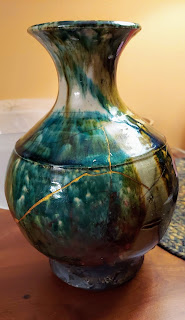
Broken raku vessel mended with gold

Hit it with a stick

I have been 'playing with clay' for over 13 years and one of the first lessons I learned as a beginning potter was that of impermanence. As my first teacher taught me, there are almost limitless ways to ruin a pot along the way. I still hear her voice in my head when I mess up centering ("an excellent way to ruin a pot"), trimming ("yup, a great way to ruin a pot"), or glazing ("a perfect way to ruin a pot"). 

I also remember another one of her adages: Hit it with a stick. Which was her answer to the question of what do I do when the pot is knocked off center. So the second lesson I learned was of transformation.

Some of my favorite bowls are the squared off pieces that I took Stephanie's advice with and hit with a stick. 


There is no such thing as perfect

There is no such thing as perfect. I am quite good at critiquing my work and picking it apart. My current favorite tea mug is one I hated when it first emerged from the kiln. 

Now I embrace its imperfections - it's slightly wonky and on the outside where I overlapped 2 glazes, there's a little crazing (spiderweb cracks). Because it's on the outside only, it doesn't pose any hazard to using the mug and has, instead, become a subtle design element that I believe enhances the look of the piece.


Our scars show our journey

The vessel in the image at the top of this post was one made by a fellow potter and fired in a raku kiln. It cracked and broke into several pieces upon cooling and my potter friend asked me if I might try to repair it using the kintsugi technique.

The philosophy of kintsugi is that of using the cracks as a way to enhance the beauty of an object, rather than attempt to invisibly mend it. 

I am also a (now retired) physical therapist and this applies to the body as well: injuries are mended, but there are often scars - some visible, some invisible - that show where we have been hurt. I have come to believe this to be true for our psychic wounds as well. 

We may very well heal, but the healed places will be different than they were before the hurt. 

If I could make my soul visible, perhaps there would be gold lines wavering through it. And I think that would be quite beautiful.


Little, Broken, Still Good

I recently re-watched the Disney movie, Lilo and Stitch and literally caught my breath when Stitch says at the end: "This is my family. I found it, all on my own. It's little, and broken, but still good. Yeah, still good." 

I have been feeling very broken lately, with the jagged places raw. There's a novel I've been poking at for several years now, only making minimal progress. Most days, when I think about opening the file and working on it, I feel as if I have failed the story and failed myself, having lost my way as a writer. 

In the enormity of the world's suffering and pain, how can I even pretend that my creativity matters? That my own distress matters. That I even deserve to feel whole?


Impermanence. Imperfection. Transformation.

I was text-chatting with a writer friend last night and they helped me see myself and my work in a different light - ironic, as *they* were the one who reached out to me because they were struggling. But that's how it works, I think. We are here to help one another.

These are some of the things I wrote - ostensibly for them - but also for me:

So many people are fighting to force things to be 'normal' but there needs to be a reckoning for all our losses. And I don't think our culture has the ability to do it. Not fully. Not in the way it needs to be done.

And those of us who have the sensitivity to see it are mocked for it. 

And I know  I get sucked into minimizing my own reactions to it all, end up wondering what's wrong with me.

I worry for the future ... and how to carry that grief and not let it consume you. I haven't figured out that at all. 

I think the sensitive ones like us are the emotion translators in the world. It can be exhausting. But it's also [critical] to do. To express in art and reflect back to the world.

[It's] work. Hard work. Necessary work. Sacred work. 


And as I wrote those final lines, it felt like something unlocked deep inside me. My broken pieces weren't grinding against one another quite so hard anymore. They fit together. Not seamlessly, but with the seams shining in the places that had been cracked apart.  

It is okay - more than okay - it is essential - to bring beauty into an uncertain world. 

Both what we create and who we are as creators don't need to be perfect. They and we can't be perfect. But if we commit to repairing the broken places with care and gentleness, gold will shine through the cracks to illuminate us all. 


Subscribe to BlueMusings and receive my short story collection, STRANGER WORLDS THAN THESE, as my gift.


Sunday, September 30, 2018

The Potter of Akrotiri


Photos taken by me at the Museum of Prehistoric Thera


The Potter of Akroteri*

She has no patience for the way the wind
whips the hair into her eyes and mouth and binds it
with a leather strap. Her back is broad from digging,
her firm arms wedge the clay free of air, her right leg
drives the kick wheel in a relentless rhythm as a pot blooms
between her capable hands. She rises
from the wheel to ease the ache in her hip, takes a sip
of cool water drawn from the cistern below her shop.
Her assistants roll coils of clay into fat snakes
that swallow their own tails round and round
as amphorae grow tall and straight. Far below in the harbor,
ships bear treasures from Crete, from Egypt, from Turkey.
Her vessels will fill theirs, trading olives and wine
from her beloved island to strangers across the sea.
We are ghosts to one another – this potter and me – we share
only the dust of dried clay and the secret knowledge
of our alchemy. In the museum, docents glare as I stand
close to each display as if they know my secret desire
to hold that delicate cup, to stroke the surface of this burnished pot.
Some were untouched by time, freed whole from the ground
that had sheltered them. Others lovingly pieced together,
archaeologists able to separate fired clay from rock and stone.
I lean in to study the decorations: complex spirals
and tiny swallows, their upswept wings captured
in a single deft brushstroke. These shapes are so familiar.
The belly of her cups will fit my palms exactly, as if
this ancient potter had just emptied her kiln
and set them out for me. 
 --LJ Cohen September 2018, Thira (Santorin), Greece


*Inspired by our current travels in Greece, my love of pottery, and the recent discovery that a skeleton discovered on Crete with unusual patterns of wear is in fact of a woman master ceramicist. 


Subscribe to BlueMusings and receive my short story collection, STRANGER WORLDS THAN THESE, as my gift.


Wednesday, November 04, 2015

Seeing the Flaws


Work from April 2013

When you've been practicing something for some time, there's a good chance you're going to get better at it. Which is totally a good thing.

I've been working with clay - handbuilding and throwing on the wheel - for 8 years at this point and I'm finally in a place where I feel I have basic mastery of form and process. I can sit down and create an intentional shape, a planned set of items, even execute a project I'd only imagined and have it work.

My skills have definitely improved significantly from where I was even a year ago. Also a good thing.

What becomes difficult, is that my critical eye gets better even faster than my hands.

I met a friend for lunch at her house last week (:waves to Bliss:) and realized she had one of the mugs pictured above. I cringed. Looking at it, I realize there's more wrong with it than right. I could make a list of the flaws in the work, from centering to shape and proportion, to finishing, to glaze application. What I am making now is far, far better than these.

Yet my friend loves her mug. It's even one of her favorites.

I think she would be mad if I gave in to my impulse to smash it and bring her a new one!

It's a good thing the mug is at her house and not mine. If it were here, I would smash it. Not from anger or frustration, but from a position of not getting overly attached to a thing, and realizing that each item of ware I create teaches me something. Once I've learned the lesson, I no longer have to keep the product. It's the process that's most valuable.

'starry night' mugs, 2015


But another lesson here is in learning to let things go.

We are all works in progress and not finished products.

This is also true of my writing.

I finished ITHAKA RISING in 2014 and after the usual process - revisions, readers, revisions redux, editor, production - it was published earlier in 2015.  Today I finished reviewing the audio book files for the story. All 15+ hours of them.

And I have to admit, there were places where I cringed in the listening. I heard all the awkward word choices, the places where character wobbled, pacing issues, inconsistencies in descriptions. It was like looking at a bowl I'd thrown a year ago and only seeing where it wasn't centered.

But, here's the thing: perfect doesn't exist. Not in handmade pottery. Not in paintings. Not in music. And not in writing stories. The craftsman is probably always going to be hardest on the finished work. What I came to realize, after having to listen to several sections over again, was that the story didn't deserve to be 'smashed'. It was . . . it *is* a good story. I can distance myself from it, just a bit, to see it through a reader's eye and see where it has a strong shape. Where it is pleasing. Where it entertains and moves. That it works.

I can see both the flaws and the strengths and be satisfied, yet still be determined to hone my craft.

Because that is what artists do. Between now and next year, I will throw hundreds of cylinders on the wheel. I will lay down tens of thousands of words on the page. If I am true to the process, what I produce then will be better than what I can produce now.

And that, too, is a good thing. 


email:

  • Free eBook
  • Free/DRM-free short fiction
  • publication news

Wednesday, August 26, 2015

Dragon Bellies!


Until Monday, this is what the ceiling in our LR looked like. . .

I've been spending time in the ceramics studio lately, looking for some peacefulness while my house is somewhat mired in chaos and construction from a bathroom leak.

I don't do chaos well. Unless it's the creative kind. I love the smashing together of ideas and concepts to create something utterly new.

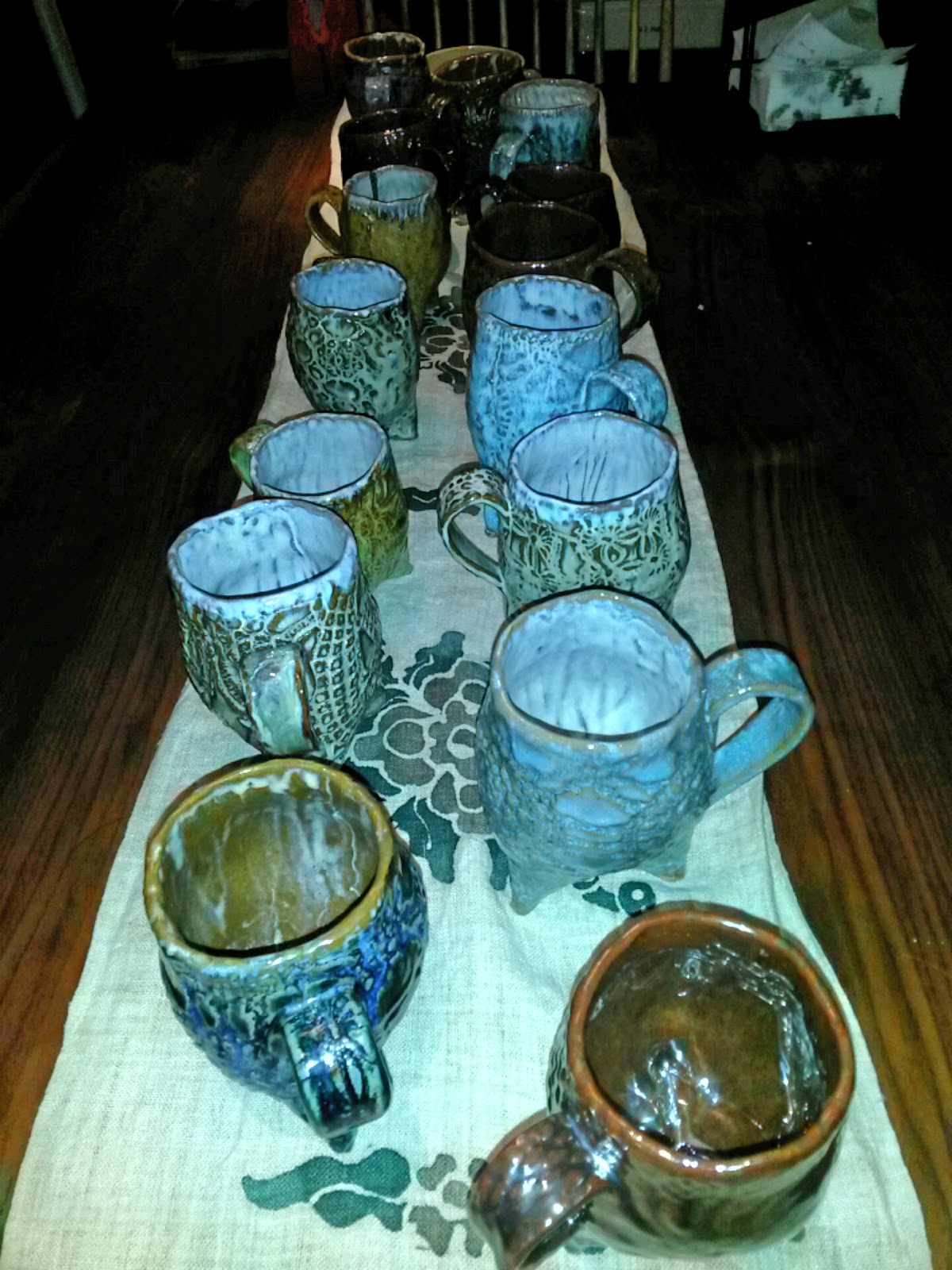
Home repair is definitely NOT that happy kind of chaos. So it's off to the studio, when I can. The past few weeks, I've been making what my writer/friend Bliss Morgan named 'Dragon Bellies' - handbuilt, textured cups with tripod feet and a distinctly 'waddling' shape.

Folks seem to like them. While I've seen other tripod/hand built work, they aren't Dragon Bellies!  I have a lot of fun making these and I love they way they look all together, like they are a little army of marching creatures.

Folks also have asked me how I make them, so I though I'd do a process post.


Slab me, baby!


Dragon Bellies start out their lives as clay slabs, about 7" wide by 12" long. Because no two finished cups are alike, and I like the slight 'wonkiness' of their handbuilt natures, I don't fret over exact specs for the slabs. The studio has a wonderful piece of equipment - a dedicated slab roller - which definitely makes things easier, in terms of getting slabs with even thickness.


It's all about the texture


Yes, I know it looks like a spider web. It's actually lace. We have a lovely collection of fabrics with great textures. I go for a large variety. Part of the fun is taking a symmetrical design, like lace, and warping it in the process of shaping the clay so it looks more organic, like skin.


Roll it up


After the textured slabs have 'set up' a bit - which means they are stiff enough to hold a shape and their own weight when stood on end, but still soft enough to mold without cracking - I roll them into tubes and start sealing the seams.

You can make different kinds of seams, including invisible ones where you miter (bevel) the edges of each end and attach them 'face' to 'face'. But I like having seams that show for these cups and deliberately cut the seam line to be ragged.

To make clay that is not very wet seal well, you have to score the edges and coat with slip (a mix of clay and water.)


You can't march without feet


I use both hands to pinch the circle into a triangle form. (I needed one hand to take the photos!) Notice how the outside edge is scored. It's then painted with slip to help the adhesion. At this point, the 'feet' are usually too soft to hold the weight of the form, so I let them dry upside down for a while.


Push that belly out


Once they can be safely flipped on their feet, I start to use my fingers to gently push their bellies out and create a shape that is pleasing, but not symmetrical. The finishing work is what takes the most time. The inside seams from the tripod feet need to be sealed with snakes of clay and smoothed. To make the handles, I usually cut off the right amount from the top of the bellied-out cylinder, which gives me a handle of the same relative dryness that matches the pattern of the mug body.  Sometime, I swap handles. Because I'm radical like that. Then the top of the mug needs to be smoothed. I use a damp chamois for that. 

Then the dragon bellies need to dry to leather hard so they won't explode in the bisque kiln.


Color me!


Once the mugs emerge from their first trip in the kiln, they are at the bisque stage - fragile, but hardened clay. That's when the glazing begins. To pull out the texture, I paint the outsides with oxides, which then must be wiped off with a damp sponge, so that the oxide is only deep within the texture. It will react with the glaze in particular ways, depending on the oxide and the glaze, to create a subtle variance of the color within the grooves of the texture.

Then the mugs are dipped in one or two coats of glaze before being fired a second time.

When they emerge from the glaze kiln, they will be fully vitrified (converted to a glass like form), non-porous, and safe to use.

Unless they reach sentience and take your kitchen hostage.


Questions


How long does it take to make one of these?
Longer than I realize. LOL. I tend to make between 4 and 6 at a time and all told, the batch takes several hours of hands-on time (rolling slabs, rolling texture, making the cylinder, shaping the cup, finishing the cup, glazing), separated by days to weeks of waiting time. (Waiting for the slabs to dry, waiting for the cylinders to harden, waiting for the finished cups to dry, waiting for kiln time, waiting for the glaze to dry, waiting for the glaze kiln.)

What does it cost to make one of these?
Well, if I needed to make my living from ceramics and had to price these relative to my materials costs, kiln charges, studio fees, and my time, no one could afford to buy one and I would be making far simpler and easier to produce work. I price them in the $30 range, depending on size, which seems to me to be a reasonable price for a piece of functional art.

Do you take commissions?
Sort of? Occasionally? The problem with commissions, is it's often not possible to create the exact color or size specifications someone wants. Glaze is chemistry, and doesn't work like paint. E.g., you can't mix blue with yellow and expect to get green. The colors emerge as a chemical reaction triggered by heat and unless you know ALL the chemical properties of ALL the glazes, you will have no idea how something will turn out until you do a glaze test.

So, if you want a set of 4 dragon bellies, for example, and you're happy with the colors I choose, (I can usually promise color families, e.g., blues or greens or neutrals) then sure, pop me a message.

The other problem with commissions, is that because my day to day work is as a writer, and I don't have the time to be a full production potter, it may be weeks or longer before I can promise finished work.

Is this all you make? Don't you get bored? 
No. and No. :) I also throw on the wheel, to make smooth, symmetrical forms including bowls from small prep size to large serving size, and cups/mugs. And bored? Playing with clay is my kinesthetic therapy. It's soothing and I end up with something that someone will use and enjoy in their day to day life. How cool is that? And having a passion that takes me out of my thinking brain is also good for my writing process.

I'm an artist too. Do you want to do a trade?
Hell yeah! That's one of my favorite things to do. I've traded for paintings, jewelry, blown glass, knitted work, wood work, and even cookies!

You can see more photos of my work on my ceramics site: http://www.dragonbellyceramics.com And wish me luck - I've applied for a spot in the juried art show at World Fantasy!

Any other questions about my ceramics work? AMA in the comments!


email:

  • Free eBook
  • Free/DRM-free short fiction
  • publication news

Tuesday, August 18, 2015

Making Space for Serendipity

starting with basic cylinders

You probably already know this, but when I'm not writing (or, let's be honest, wasting time on the internet. . . ) I spend time at a wonderful local ceramics school and studio space both handbuilding and wheel-throwing clay into primarily functional objects.

It's become somewhat more than a hobby, though I don't see myself becoming a production potter. One of the things I've learned over the years is that it's important to have a plan for the clay. While it's fun just to play with a piece, if I don't have a sense of what that clay will be at the end, then what I'm left with is a mud pie.

When I'm not throwing on the wheel, I work with textured slabs of clay and create somewhat freeform tripod cups and mugs that I call 'dragonbellies.' In the photo above, you can see several small cylinders, along with one small shotglass sized cup in process. To the left is a large cylinder that I had intended to turn into a water pitcher.

Since the large cylinder was slower to dry than the small ones, I wasn't able to make what I wanted that day, so I wrapped up the clay in plastic, intending to return the next morning. Except that I got busy and days turned into a week, interspersed with a trip out of town.

When I got back to the studio, the cylinder was nearly leather hard - somewhat past the stage of being able to shape. So I decided to try to reclaim it by soaking the newspaper it was wrapped around and wrapping it up again. Several days later, the water had make the clay softer. Success!

I started working on forming the pitcher.

When I got to the spout, I realized the clay really wasn't soft enough after I had already cracked it. Which meant either a radical re-think, or time to recycle the clay.

Adding a 'button' to the repaired/remodeled spout

So I used some scrap clay to buttress the spout. But I didn't like the way the whole thing looked and was going to scrap it. Until one of my fellow clay artists suggested I round the edges of the new spout and add 'buttons' on the sides so the water wouldn't slosh over it. Again, playing with scrap clay, I rolled a thin rope into a spiral and put it next to the spout to see what I thought. And voila! I created an owl!


oh, hello there!


I'm not sure I would have liked the piece as much had my first idea worked. Certainly, I don't think I could have created this funky face had I set out to make a sculptural piece.

Serendipity.

A happy accident.

This is something I try to leave space for in my writing as well. This is why as much as I like to organize and plan a story, I need to give it enough wiggle room to expand my initial (usually limited) ideas.

Creativity is a strange beast. Probably a lot stranger than my owl pitcher. But just as unexpected. And definitely as much fun.

#SFWApro


email:

  • Free eBook
  • Free/DRM-free short fiction
  • publication news

Friday, January 09, 2015

Trying to find center

Centering the clay, photo by BLW photography, used with permission, CC by 2.0


We are only nine days into the new year, and I'm already feeling overwhelmed. Although I'm not sure why I continue to believe that my life starts on a blank slate every January 1st. I am starting to realize there are not really endings and beginnings, only continuations, as one day blends into the next, one year into the next. It puts the concept of New Year's resolutions into a different kind of perspective for me.

What it means is that at any moment, we can choose to take a new course; that paradoxically, every moment is a chance for something to begin or something to end.

Anyway, enough philosophizing.

Even centering - the title of today's blogpost and the photo used above - is not entirely a metaphor. In ceramics, if the clay is not centered, you cannot throw. That's what happened to me last Friday. I wedged up a half-dozen balls of clay, planning to throw medium and large serving bowls.

What I accomplished instead was an afternoon of mud pies.

Nothing would center. Frustrated, I tried to open the clay and pull up the walls anyway. For my pains, I got what potters affectionately term 'the death wobble.' That's where the opening is not centered (natch - because the clay on the wheel is not centered) and one side of the wall is thick, the other thin. When the wheel spins, the clay wobbles and torques or collapses.

In movement, too, we need to be grounded in our physical center - the center of gravity - in order to function. Otherwise, we fall.

So yes, centering is a very real, physical phenomena.

And it's also a metaphor.

Right now, I'm feeling out of center. There's a lot going on in the next several weeks - much of it wonderful - but still, I'm having trouble staying in balance.

Between now and the middle of February, I will be attending Arisia and participating in the art show, readying TIME AND TITHE for publication, traveling to Iceland for a week (Yikes! But cool!), launching TIME AND TITHE, and attending Boskone, where I'm both in the art show and on panels.

:Takes big, deep breath:

My job in the next few weeks is to look for centering. That means not rushing the process on the wheel at the ceramics studio. That means not rushing about mindlessly (which I was doing yesterday and which meant that I started the day dropping and smashing a wrapped ceramic cup meant for a friend because I didn't take the time to be present.) That means taking the time to breathe, to do yoga, to shut down distractions when it's time to write.

May you be centered in your day and find the balance you need.

Thursday, December 18, 2014

2014: Looking back, looking ahead

Switchbacks; photo by Don Graham, CC BY-SA 2.0

It's funny. Every year ( 2007, 2008, 2009, 2010, 2011, 2012, 2013)  I do one of these round-up posts, and every year it amuses me how my plans tend to take a sideways turn. I suspect this is inevitable, as life continually throws curve-balls. And being flexible to what comes is a strength.

When I was looking forward toward 2014, I was optimistic that DERELICT would sell and be published by one of the 'big guys'. I had planned to publish FUTURE TENSE under my own imprint, and focus on completing TIME AND TITHE, the sequel to THE BETWEEN, also planned for my imprint, figuring that any path to traditional publication would take a year or more. (One of my mottoes is always keep moving, or as Dory says in Finding Nemo "Keep swimming! Just keep swimming!")


However, When 2014 actually showed up, it had a very different shape to it.

I did end up publishing FUTURE TENSE in February of 2014, and that was just the start of what would prove to be a chaotic and exciting time for me.


 My agent and I parted ways in late spring after it became clear to both of us that we were not a good match for one another. That left me feeling someone at loose ends and more than a little nervous. But it also left me free to publish DERELICT under Interrobang Books, the imprint I founded in 2012.


 I had no expectations on June 1 when I hit the publish buttons on all the retail platforms. I knew I had written a solid book, but that didn't guarantee anything. My experience in publishing my first 2 novels was that I could sell a few hundred copies, reach some enthusiastic readers, and get some honest and thoughtful reviews. I believed that having more work for sale would improve my chances of discoverability, and I made sure the release would be in time with Readercon (where I was on the program) and joined Broad Universe (an organization of women writing in SF&F) so I could have copies of my books for sale in the dealer's room. Beyond that? I reached out to my newsletter subscribers the week the book came out and kept my fingers crossed.

After several days of modest and steady sales, something happened. Something magical and wonderful. DERELICT started selling. And selling. And selling. In the past 6 months, I have seen nearly 8,500 copies of my books sell. That is a significant number for an indie author. My earnings from DERELICT alone are higher than I would likely have made had my former agent sold the novel. (A good ballpark figure for the advance on a debut SF novel in today's market is $7,500. Most published books never earn more than their advances.)

And so, my writing life took a series of hairpin turns and now I'm traveling in a direction I had never anticipated.

I will continue to publish my novels under Interrobang Books. TIME AND TITHE is slated for a mid-January 2015 release, two years from the publication of THE BETWEEN. I am thrilled that I was able to return to the world of the Fae and continue Lydia's story.

DERELICT will become book 1 of a new series. Book 2 is well into its draft phase. My plan is to have it ready for release in June of 2015, and then a new book in the series yearly.

I will continue to blog here and pen the occasional short story.  (Which you will have early access to if you subscribe to my very occasional newsletter.) Which reminds me of another of 2014's accomplishments: I put together a collection of my short fiction, STRANGER WORLDS THAN THESE. It's for sale as an eBook for .99, but subscribers receive it free.


 In January, I will be at Arisia, reading with Broad Universe and I'll be exhibiting my pottery at the art show! (This is a new venture for me in 2015. While I have been doing ceramics for quite some time, I'm now confident enough to show my work.) In February, I'll be on program at Boskone, as well as in the art show. If you're at either con, please find me! There will be paperback copies of each of my books for sale. 

'it's full of stars'

 My goal for 2015 is also to stay open to new possibilities and new opportunities as they arise. I have joined The Scriptors, an indie author collective, and am talking with another author friend about a project he has in the works.

The world of publishing changes in an eye-blink. Indie publishing has changed significantly in just the 2 years since I published my debut title. I have no doubt that it will continue to evolve and shift. What doesn't change is my commitment to write books that delight and surprise readers. I have always believed that creation is a journey and a partnership between the creator and the audience.

I hope you will continue to travel this road with me. 


Thursday, October 09, 2014

Sometimes you have to hit it with a stick

. . . Or why revising is like trimming in ceramics.


This is what a bowl looks like after it's been thrown and taken off the wheel to dry for a few days. Do you see the thick mass of clay at the base of the bowl? (It's upside down, so you are looking at the 'foot') That's clay that will need to be trimmed away to reveal the profile of an ideal bowl.


First you need to trim the bottom of the bowl flat.

Then you choose the diameter of the foot and trim away the excess.


Trim the slope of the side smooth from foot to body of the bowl.

To remove weight from the bottom of the bowl, and to create the 'ring' of the foot, carve away excess from the base.

Now we have a bowl with a nice balance of foot to body, and a foot that fits the slope of the bowl.

Unfortunately, when I went to remove it from the wheel, I compressed the side, warping it. And once that happens, there's no way to recover it to round.

So I did what one of my teachers taught me. I hit it with a stick.

Now I have a squared-off bowl.
That will be a dramatic piece, like this one. (Yes, I've done this before. . .)

This is the 'revising' phase of ceramics.

In writing, the first draft is the just-thrown bowl. You really can't do much with it. It needs to dry, to set up so it can be shaped into something finished, something able to be used. While a piece of ceramics will reach that stage in a day or two or three, a first draft story often needs to sit for weeks or months, letting time pass between the writing and the revising so that the writer can approach the work as new again.

Revising a manuscript is the act of shaping and altering. And just like something doesn't work out exactly as you'd planned, you can hit your story with a stick. Metaphorically, of course - turning it into something that may be quite different than your original conception.

And that's okay.

Not all bowls need to be round.


Wednesday, September 24, 2014

Oh, hello, again!


It's officially Fall: aka the busy season. I got the last of the tomatoes canned and put away on the pantry, and it's about to be apple-palozza time. Apple sauce, apple butter, dried apples, apple-pepper jelly. . . Preserve all the things!!

I do need to slow down a bit - with both my sons away at college, it's just hubby and me needing to be fed. We still haven't figured out meal portioning for two. Which means we're only really cooking every other day, since the leftovers are a full meal for two. :)

I also finished the revision pass for TIME AND TITHE this week.


Thank goodness for post-it flags! Now I get to incorporate all those handwritten notes into the document so I can email it out to my beta readers. I'll have time for round two of edits/clarifications before it goes off to the editor on November 1. The cover artist is in her creative process, so we're on track for a mid-January 2015 release.

Next up: the first draft of DERELICT's sequel. I'm really looking forward to that unchained burst of creativity that comes with starting a new project. Before the muddle of the middle sets in.

What else am I doing? I switched ceramics studios in August. After years of working at the New Art Center (which is wonderful, but I was looking for the next phase of my development as a ceramics artist), I moved to The Potter's Studio and have been getting oriented to the new place: new clay bodies, new glazes. It's been challenging and fun.

I love the jewel toned glazes on these cappuccino mugs. Now I need to find combinations I like for my textured hand-built work.

And, as if I wasn't busy enough, I wandered into a fiber shop during our recent trip to Watkins Glen and ended up buying some lovely yarn, a set of needles, and a hat pattern. It's been nearly 20 years since I've picked up knitting needles.


I'm amazed at how the motor memory came flooding back. Now I have this jaunty little hat, just in time for the cooler fall weather.

So that's my update.

Have a wonderful day, my internet lovelies!


Monday, July 14, 2014

Odds and Ends; Things and Stuff

Old dock, Chesapeake Bay, MD
Hullo all! We are down on the Eastern Shore of the Chesapeake Bay in Maryland at the peaceful retreat that is my in-laws' place.

For the next week, I plan on reading and writing and staring out at the bay, watching the osprey chicks fledge.

Last weekend, I had the opportunity to be on the program at Readercon and had a totally lovely time. I was on several really interesting panels, including one on the science and logistics of space colony living and one on dealing with discouragement. Great conversations ensued. I also got to meet and network with some amazing ladies from the Broad Universe group. I am really looking forward to getting more involved in the organization and promoting more women writers of SF&F.

If you follow me on Google Plus (my social network of choice), you know that I've been sharing and resharing posts about helping a fellow plusser and creative person (writer and artist) who is under imminent threat of home foreclosure. I figured I'd offer some of my ceramics as a perk for folks to donate to Tressa Green's gofundme campaign. What I never counted on was that the hashtag #KeepTressaHome would take off like wildfire on G+ and that tons of other plussers would also offer perks for donations.

I'm so proud of my community and their generosity and caring!! You can read more about the campaign and all the amazing perks being offered here: https://plus.google.com/113113447782383069533/posts/LMxQkwniUcV

So check out the link for your chance to have one of these (or something else that I make) as your very own, or one of many, many unique perks donated by others.

"dragon belly" mugs

It's cool stuff for an important cause. Please consider a donation, or at least spread the word. Thank you!


Thursday, February 06, 2014

Thoughts on "The New Caste System"

Donald Maass wrote a thought provoking essay on his thoughts about the current state of publishing, looking at writers and where they fall in the publishing/self-publishing spectrum. I have pulled out some quotes, indented and italicized below. You can read his post in its entirety at Writer Unboxed.

He lays out his vision by rejecting the view that the sky is falling and here I am in complete agreement.

What’s happened instead is an evolution of the publishing world into a new class system, and like any class system it has winners, losers and opportunities.
 While there is certainly a perceived class system/hierarchy/stratification within the population of authors, I'm not sure this is anything new. There has always been a town/gown rivalry between writers of genre fiction and literary fiction, for example, with genre fiction perceived as always 'less than' literary writing.

Then there is the hierarchy between a-list authors and mid-list authors, where the a-listers have always received the lion's share of publisher resources.

Look at the controversy in literary prizes in terms of male vs female writers; if that's not a class system, I don't know what is.

No, stratification in the publishing world is nothing new. However, I don't agree with how Maas breaks out his layers, with self-published genre writers relegated to freight class.

Maass initially says:

. . . the self-publishing movement has been a boon to the print industry. Far from being threatened, print publishers instead are now gratefully relieved of the money-losing burden of the mid-list. Like giant banks that have discovered that banking is boring and the real money is in gambling, big publishers are now free to focus on the high-risk/high-reward game of finding the next Twilight, Hunger Games, Game of Thrones or Fifty Shades of Grey.
And this is patently obvious in the shift to bigger and more monolithic publishing houses and the flurry of 'me too' books that are published in the wake of a single blockbuster.

However, when he describes which authors travel which classes, he described freight class this way:

. . . for the most part it is an ocean of genre imitations if not amateurish writing. Freight Class novels generally take few risks. Too often they rely on character stereotypes, heavy-handed plots, purple and obvious emotions, and messages and themes that are time-worn. Justice must be done. Love conquers all. Good vs. evil. Freight Class fiction can be easy to skim. Literary flourishes are few, cliffhangers are many. Genre conventions are rigidly honored. Characters are not motivated from within, for the most part, but instead are pushed into action by external plot circumstances.

To my eye, this looks like the tired argument against genre fiction in general, which is surprising, given that Maass is a literary agent who represents many extremely talented SF&F writers. While he doesn't expressly say it, freight class is the ghetto of the self-published writer in this system.

The next higher class is coach. These books are characterized by:

Readable pages, appealing characters, clever premises, attention-grabbing plot hooks, a display of craft and art, emotional engagement, and themes that “resonate”…

While characters can be motivated from within, their inner journeys can feel somewhat painless. Readers are “engaged” but don’t always feel deeply moved. Coach Class fiction sometimes borrows secondary characters from history or classics, retells other stories, or stretches into series that can become thin. Genre conventions may be borrowed or blended but essentially they are not violated.
Coach class authors seem to be those genre/commercial/mid-list writers who have been published traditionally. As Maass says:

Coach Class authors, however, are professionally edited and get goodies like nice covers, ARC’s, and plenty of blurbs. Plus, their books are in bookstores, a big boost in visibility.
First class, in this schema, seems to be the literary a-list:

First class novels shake our way of thinking, challenging us to see the world in new ways. They confidently break rules, may transport us to unlikely cultures and times, teach us things we knew little about, and always feel utterly unique. Each novel creates its own genre. First Class fiction is imitated but never matched. Its authors are revered and for good reasons.

And while Maass does talk about writing quality in all three classes, for the most part, he treads old ground by placing self-published writers at the bottom of the pile, genre writers in the middle, and literary writers at the top.

As a writer, working hard to pursue a hybrid path (I have an agent and I've self-published), I am not here to engage in any sort of traditional versus independent publishing debate.  However, I do think about this differently than Maass, and part of that comes from my work in making pottery.

a set of coffee mugs in process, bodies thrown on the wheel

For the past 5 years, I have been working at a local pottery studio, throwing on the wheel and handbuilding a variety of decorative and functional objects. In the ceramics world, there are artists who craft incredible pieces of sculptural beauty and intricacy. And there are production potters who make lovely and elegant functional pieces - mugs, bowls, and plates - to be used and appreciated.

When I go to a craft/art show, I don't judge a purely sculptural piece as inherently better than a mug whose colors draw the eye and whose body fits perfectly in my hand.

I wouldn't call the potter of functional wares a member of a lower class of ceramics artists than the sculpter of decorative pieces. (Now, we are not including the clumsy work of the beginning potter here. Just as I wouldn't include the writer who hasn't mastered basic craft in any of the 'classes.')

'dragon belly' mugs. A little wonky, meant to be used and enjoyed

I am no longer a beginner, though I chose not to become a production potter. (This is more because of constraints on my time and the fact that I do pottery as a creative outlet and respite from stress.) However, I am in no way a ceramics artist. Yet, my work has been chosen for juried exhibitions and I have been asked to make several commissions.

I enjoy making functional work that people use and appreciate.

And I believe there is a place in publishing for books that are the equivalent.

I believe that there are many, many kinds of books that "shake our way of thinking, challenging us to see the world in new ways" and that capacity does not exist only in Maass's first class. Nor would I stratify writers/books in the way that he does. Those clumsy books, with clunky prose, cliche-ridden plots, and flat characters don't even have a ticket on the train. They are the equivalent of the student potter, unable to control the wheel and center the clay and create work purely by accident.

I may appreciate the hard work of the beginning potter and even attend the student show at the studio, I wouldn't buy the out-of-round bowl, or the mug with the too-small handle.

Yes, the ease of self-publishing has allowed those beginning/developing writers to rush to the marketplace, but the presence of poorly make pottery doesn't mean that all functional potters are shunted to freight class. In addition, there are many, many other writers who are competent craftspeople. And when I want a story to go with my morning coffee in my well-turned, well-trimmed, smooth-glazed mug, that's what I choose to read. 


Friday, November 22, 2013

Sleeping Gardens, Teapots, and Acceptance


Kintsugi: Golden Joinery, photo by tschorda, used with permission, cc license

Over the past few weekends, my husband has been busy in our small yard, clearing out the raised beds and raking leaves. No matter that I know late Autumn and its drab browns and grays come to my part of the world every year, it still brings with it a particular kind of sadness.

I often wonder if my moods would be more even and tempered if I lived in a place that didn't have such a stark change of seasons.

But then I think about how much the monochrome of winter soothes me and how much a snowfall can make my heart light, and I can't imagine living somewhere without it.

Perhaps it's not such a bad thing to be in tune with the shift of light and weather. This is the soil I was rooted in, after all. I need the fallow times as much as the intensity of the short growing season.

***

I'm working hard at acceptance. It's something I can usually do in the ceramics studio. Just yesterday, I trashed a teapot I had made after studying it and learning what it was I didn't like about it. (Handle didn't balance the weight of the pot well, spout dribbled, lid didn't seat well.) While I was disappointed that I had yet again made a poor teapot, I didn't beat myself up about it. It was just clay and time. I have more of both. And failing to master a teapot didn't make me a terrible person or a failure. It just meant I have more to learn. And teapots are hard.

***

I don't blame the garden because tomatoes don't grow all year round.

Yet, I still blame myself for so much that is outside of my control.

***

It's so easy to put impossible standards on ourselves. The messages are everywhere in subtle and overt ways, and I'm not even talking about visual standards of beauty that no one - not even the supermodels themselves who are in the photographs - really match. No, I'm talking about the nagging sense of never being good enough to match some impossible always-just-out-of-reach goal.

Don't get me wrong - goals are not the problem. It's the way we choose goals that make who we are right now feel like a failure. 

***

One of these things is not like the other. 

I remember watching that game on Sesame Street with my kids when they were little and realizing how hard wired we are to see differences.

Yesterday, I retrieved 4 small bowls I had made from the kiln. My teacher was thrilled at how they had come out and hoped that I was also pleased. She said she was really proud of me and all the work I'd put in to creating a consistent shape and elegant glazing.

After the brief flush of pride, I immediately latched on to all the flaws in the pieces.

We are so damned expert at seeing the differences and labeling them as wrong. As failure.

***

I recently read about the Japanese art of repairing broken ceramics with gold resin, called kintsugi.  It is thought that the repaired vessel is even more beautiful because of the cracks.

I wept when I saw that.

***

There is a difference between inflated ego/false pride and acceptance.

Acceptance isn't self-deprecation or resignation.

How can we see ourselves as we are and apply the same acceptance and gentleness we offer to others?

How can we see our broken places as part of our beauty?

That's what I'm working on in this fallow season.

Saturday, August 03, 2013

Working out of your comfort zone

It's easy to fall into habits that then become a kind of invisible trap. I think it's the flip side of the practice to mastery effect. If you're not very careful, what you do becomes the only thing you can do and a way to break out of this is to deliberately push yourself to stretch into something new and different.

When I'm not writing, I spend time crafting ceramics and throwing at the wheel is a skill I've been practicing for over 5 years now. I had gotten fairly good at throwing 1-2 pounds of clay, which can make anything from a large coffee mug to a small bowl. Whenever I tried to throw larger, I would have a difficult time and end up with either cow plops of clay on the wheel, or the death wobble and a warped pot.

But in the back of my mind, I had this goal of making a tea-pot. At the end of last term, I was determined to throw 3-4 pounds of clay and make the $#!@ tea-pot.

It was tough on my hands and back (throwing takes a lot of leverage and strength), but I succeeded in making a tea-pot large enough to hold over 2 8-oz cups of tea. (Except for one minor problem. . . )

When I started the summer session, I went back to my 1 1/4 lb mugs, as I had promised a friend I'd make a set for her. What I discovered was I had made a huge leap in my skills with smaller amounts of clay. Suddenly, it was even easier to control the clay and create consistent shapes. Somehow, my hands had learned the shape I wanted.

I attribute this to pushing out of my comfort zone and trying something I knew would be hard for me. When you then return to the familiar, even that has changed.

I'm in a similar place with my writing. After completing 8 novels, most in the YA or 'NA' realms, I've been drawn to a very different story that I had started and abandoned a few years ago.

It's something well out of my typical comfort zone: it's an alternate-world fantasy that is also fairly explicit erotica. When I stopped working on it a few years ago, it was for very good and practical reasons: I want to focus my career on YA writing. I suspect few YA writers are also able to successfully publish erotica. (I imagine irate parents marching en mass with torches and pitchforks. . . )

And, well, I'm an intensely private person and wasn't comfortable with readers reading my explicitly sexual scenes.

So why did I go back to this story? (Working title: The Sisters of Lilith)
  • Because I like the central idea and the characters. 
  • Because if I'm uncomfortable with writing something, that's a sign I need to figure out why. 
  • Because if I master the sexual tension that this story needs, I'll be able to bring appropriate elements of that into my other writing. 
  • Because a writer writes and shouldn't shy away from what's difficult.
I haven't decided what I'm going to do with this story when it's complete, but I'll cross that bridge when I get to it.

In the meanwhile, I'll be here, struggling with a larger lump of clay. :)

Saturday, July 27, 2013

Why should things be easy?


Frustrated Artist, photo by CortneeB, used with attribution, cc license

I've noticed a slew of posts on G+ from authors looking for information on making their manuscripts into eBooks and sharing their frustration that it's a difficult process. Having struggled with that learning curve myself, I get that. I do.What I don't understand is the sense of outrage that the process isn't simple.

Why should everything be simple?

Writing a book isn't simple. Creating a world, characters, plot, constructing sentences, paragraphs, scenes, and chapters--none of that is easy. Achieving 'the end' is an accomplishment worthy of celebration. And that's not even counting the work of revision and editing.

So why should designing the physical and electronic book be easy? It's still a process of creativity and design. Why is it that we live in a culture that seems to crave assembly-line goods at the cheapest price? If something is worth doing, it's worth doing well and that means either taking the time to learn to do it well or paying someone else to do it well.

Typography is a technical skill and an art. I appreciate the knowledge that goes in to creating a beautiful book. While an eBook doesn't lend itself to all of the same kinds of typography, there are design choices that make an eBook easy to read and lovely to look at. It's not something I expect to come automatically at the press of a button.

One of my hobbies is creating ceramics--both throwing on the wheel and handbuilding. I've been taking classes for 6 years and only this year, have been able to sit down at the wheel and create what I have in mind, consistently. If I took into account the cost of the classes and the time at the studio, if I were to sell my work, I'd have to charge something like $30+ a coffee mug to cover my expenses. I can most likely go to Target or Wallmart and buy a ceramic cup for $5. But that cup is likely to be generic and mass produced. Which is not bad or evil. It's just not a piece of art.

One of my side-jobs is to format eBooks. I sometimes do print books as well, but my typography skills are definitely not as good as a professional typographer. It's not a simple process, even though I've automated some of it. I spent a lot of time and effort learning how to get it right. This is a copy of my process that I posted on G+ earlier in the week. You may find it useful or educational.

TL;DR: This is a detailed description of my process for creating print and eBooks from a manuscript. Doing it right (ie, not settling for a generic looking book) takes time, patience, and knowledge.

So for those of you curious as to what kind of work goes into formatting a book for print and eBook conversion, on Monday evening +RJ Blain  sent me her manuscript for The Eye of God as an rtf file. (Outputted from Scriviner.) I finished with both parts of the work this evening (Thursday) .


The Print Book:


But even before I was ready to physically manipulate the file, we had a conversation about what look/feel she wanted for the book. That included choosing a typeface, the trim (book) size, heading and scene break styles, and body paragraph and initial paragraph styles.

For the font, she chose Garamond which is a slightly old-fashioned and elegant serif font that matched the feel of the story. She had a strong preference for simple over complex initial paragraphs, so we chose to place the first word of each chapter in small caps and no-indent. She also did not want a dropped cap. For the scene changes, she wanted a glyph rather than a space or a typographic mark and I was able to find a freely available line drawing of a sword.

I added the sword motif to the chapter headings as well.

Once the basic stylistic decisions were made, my real work began. I saved a copy of the manuscript and set it up with the correct paper size, orientation, margins, and default styles. (Yes, I work in a word processor. It's not the best tool for desktop publishing, but it's the one I'm most comfortable using and with a solid group of styles, I can create professional looking book files.)

~I set the chapter titles as headings.
~I added the sword glyph as chapter decoration and scene change mark
~I set the initial chapter paragraph style
~I set the following paragraphs as the default style

Then I scrolled through the document looking for pages with awkward scene or chapter breaks. I needed to ensure that no scene ended at the absolute bottom of a page or that no chapter ended with a single line alone at the top of a page. In order to fix the layout, I needed to play with individual page settings, font spacing (kerning) and line spacing (leading).

In fact, I played with several combinations of font size and leading until I found a good compromise between readability, page count, and widow/orphan control (those pesky abandoned lines). This needs to be done BY HAND, not by the program.

That work took me the better part of 2 full days. It would have been finished sooner, but I also did a final copyedit pass, which I don't usually do when I format/convert manuscripts, but Rebecca asked nicely. :)

Once I had a file I was satisfied with, I exported it as a pdf and paged through it several times more. Looking carefully, I was able to spot areas that needed to be tweaked and re-exported.

The eBook:

I have a workflow for eBook creation that uses freely available, open source programs as automation tools as my starting point. I combine the initial output with additional editing tools to hand tweak and alter the CSS (cascading style sheet) used to create a backwards-compatible, elegant eBook.

I've outlined the start of that process in my illustrated creative-commons guide. (http://www.ljcohen.net/downloads.html#ebook)  It starts with the manuscript saved as an odt (open office) file and imported into calibre.

I use calibre to convert the file into an epub. This automates the creation of my CSS stylesheet from the initial document styles. (Yes, this can all be done by hand in html. This is faster for me.)

I examine the first file in my browser, in iBooks, and Google play on my tablet and note what I like and don't like about the look/feel of it.

Then I open the epub in Sigil, an epub editor and hand-tweak the stylesheet until I get the output I like. This may entail changing indents, spacing and placement of headers, checking for size and placement of the scene change glyphs, etc.

Once I have the epub that works, I make a copy. I change the  metadata to indicate that this will be a MOBI edition, along with the correct ISBN,  and import that epub into calibre as a new source for converting to mobi.

(I do this because I have found kindlegen to make errors in its conversion that breaks the metadata table of contents.)

The eBook took one full work day to get right.

I take the time it takes because I'm a perfectionist when it comes to creating books. After spending months or years writing something, revising it, and editing it, it deserves to go out into the world looking its finest.

So if you've been wondering where I've been this week, wonder no more. :) And The Eye of God is a cool story!

Friday, June 21, 2013

Almost Perfect

Sometimes you get pretty close.

Sometimes something you've planned and worked hard on comes out exactly the way you want.

But not always.

This is one of *those* times.


I made this little teapot as the final project of last semester's ceramics class. I wanted a teapot that was about 25% larger than the beehive one I used as my everyday teapot because it was just a little smaller than two normal (Lisa sized) tea mugs.  There are a ton of things I absolutely love about this pot.  
  • It's the right size
  • It's a happy shape
  • It has a little 'hat' for a lid
  • The lid fits precisely
  • The glaze looks like little fish scales
See how nice the shape is? I've worked hard, practicing on the wheel for over 5 years to be able to do something like this. It's also well balanced in the hand and not too heavy. For this teapot, I was able to throw the spout and the cover, which were both new skills for me.


 So what's the problem?

Um. Well. You see. . . The holes inside got sealed in by the glaze.

So I have this utterly lovely, perfect, and perfectly unusable teapot.

We're still getting used to the way these new glazes flow and although I blew in the holes after I glazed the teapot, it still flowed into the holes.

Ahh well. I'm still pleased in what I was able to do and the next time I sit down at the wheel, I can recreate this teapot. Only this time, with much bigger pour holes.